
A field guide to the United Nations General Assembly,
the priorities shaping the 81st session,
and what African leaders, organisations and delegates
should be trying to accomplish in New York
The 81st session of the United Nations General Assembly is just a few weeks away.
Our founder, Ms. Nthanda Manduwi spent two years based at the United Nations through her work with UNDP, and she has attended the last four United Nations General Assemblies from different vantage points.
Her first experience of the annual high-level period was from inside the UN system, where the work involved understanding how institutions prepare, coordinate and position their priorities around the General Assembly. In subsequent years, she has returned as a delegate representing youth and African interests, moving through the much wider ecosystem that forms around the official proceedings in New York each September.
Those experiences produce a somewhat different understanding of UNGA from the one conveyed by photographs from the General Assembly Hall.
The United Nations General Assembly is an institution. High-Level Week is a diplomatic moment. Around it sits a much larger temporary ecosystem of governments, international organisations, development institutions, investors, foundations, companies, universities, civil society organisations, media houses, youth networks and advocacy coalitions. For approximately two weeks each September, many of the people who shape international policy, finance and institutional priorities are concentrated within a few square miles of New York City.
That concentration creates opportunity, but it also creates noise.
Delegates can spend a week moving from breakfast panels to plenaries, receptions, side events and dinners without materially advancing the work that brought them to New York. Organisations can leave with photographs, business cards and visibility while being no closer to the financing, policy relationship, institutional partnership or political commitment they needed when they arrived.
The value of UNGA therefore depends substantially on preparation.
For governments, the relevant question is not simply what position will be articulated from the podium. It is which negotiations should move, which bilateral relationships need attention, which capital should be mobilised, and which institutional reforms should be advanced.
For civil society, business and youth delegates, the same principle applies at a different scale. Attendance is not itself an outcome. The useful measure is what becomes possible after the week that was not possible before it.
UNGA81 is especially important in this respect. The international system entering the 81st session is markedly different from the one that gathered for the UN’s 80th anniversary a year ago.
Understanding what “UNGA” actually means
The 81st session of the United Nations General Assembly formally opened on 8 September 2026 and will continue for a full year. What most participants outside the diplomatic system refer to as “UNGA” is the September high-level period, when heads of state and government arrive in New York and a large concentration of official and unofficial events forms around them.
In 2026, the broader High-Level Week runs from 18 to 28 September. The General Debate, during which national leaders address the Assembly, is scheduled from 22 to 26 September and resumes on 28 September. Additional mandated high-level meetings continue through 29 September.
That distinction matters because there is no single UNGA programme that an attendee can simply follow from beginning to end.
There is the formal General Assembly programme. There are mandated high-level meetings. There are bilateral meetings organised by missions. There are UN agency events. There are convenings hosted by foundations, businesses and civil society organisations. Climate Week NYC runs alongside the General Assembly. African institutions organise their own policy and investment forums. Governments host receptions and closed meetings. Private organisations convene dinners and roundtables that may never appear on a public calendar.
UNGA is therefore better understood as a temporary diplomatic and policy ecosystem than as a conference.
Participants who arrive expecting a conventional conference programme often discover this too late.
From UNGA80 to UNGA81
UNGA80 opened under President of the General Assembly Annalena Baerbock with the theme “Better Together: 80 years and more for peace, development and human rights.” The session coincided with the UN’s 80th anniversary and placed considerable emphasis on defending multilateral cooperation, implementing the Pact for the Future, advancing the Sustainable Development Goals, protecting the UN Charter and beginning the institutional reforms associated with the UN80 Initiative.
Watch the BBC Africa Townhall on AI and the Future of Work at UNGA 80
The 81st session is chaired by Khalilur Rahman of Bangladesh under the theme “Restoring Trust, Managing Transformation: A United Nations That Delivers for All.” His programme is organised around six interlocking pillars covering peace and security; sustainable development and the SDGs; climate; rights and humanitarian protection; artificial intelligence, science and digital inclusion; and reform of the multilateral system.
| UNGA80, 2025 | UNGA81, 2026 | |
|---|---|---|
| Central theme | Better Together: 80 years and more for peace, development and human rights | Restoring Trust, Managing Transformation: A United Nations That Delivers for All |
| Institutional context | 80th anniversary of the UN; Pact for the Future implementation; defence and renewal of multilateralism | UN80 reform moving further into implementation; selection of the next Secretary-General; pressure for measurable institutional delivery |
| Political emphasis | Reaffirming cooperation at a moment of fragmentation | Rebuilding trust through delivery and reform |
| Development emphasis | SDG acceleration, financing for development, youth, Beijing+30, AI governance | SDG delivery, right to development, climate and just transition, pandemic preparedness, digital inclusion |
| High-level policy questions | Can the multilateral system still coordinate collective action? | Can the multilateral system produce results credible enough to retain political trust? |
| Implication for African delegations | Reassert African voice within global commitments | Translate African priorities into financing, institutional reform, productive investment and negotiating positions |
UNGA80 was commemorative in a substantive sense. It looked backward at eighty years of multilateralism while asking whether the architecture created after the Second World War remained capable of meeting contemporary crises. Baerbock’s presidency repeatedly framed the UN as an institution under political and financial pressure that required renewal rather than abandonment.
Rahman’s framing begins from a related concern but places greater emphasis on performance. At the opening of UNGA81, he argued that trust could not simply be requested and would have to be earned through decisions, honoured commitments and results. He has connected institutional legitimacy directly to whether the UN can demonstrate concrete value to the people in whose name Member States act.
That distinction should influence how delegations approach this year’s Assembly.
There will still be declarations. There will still be speeches. But the language of UNGA81 increasingly points toward implementation, institutional reform and demonstrable delivery.
The official agenda for 2026
The formal calendar provides an indication of where international attention will concentrate.
The annual SDG Moment takes place on 18 September. The General Debate begins on 22 September. On 23 September, the Assembly will commemorate the fortieth anniversary of the Declaration on the Right to Development and hold a high-level meeting on climate action and the just transition. Sea-level rise follows on 24 September. Pandemic prevention, preparedness and response is scheduled for 25 September. The twenty-fifth anniversary of the Durban Declaration and Programme of Action is marked on 28 September, followed by the high-level meeting on the elimination of nuclear weapons on 29 September.
The President’s six priorities provide the broader frame within which those meetings sit. They encompass peace and security; sustainable development; climate and environmental resilience; human rights and humanitarian protection; inclusive digital governance and artificial intelligence; and reform of the multilateral system.
For delegates, however, the official agenda should be treated as the beginning of the analysis rather than the conclusion.
The useful question is how the global agenda intersects with the issues a delegation can materially advance.
What Africa should be carrying into UNGA81
The Office of the Special Adviser on Africa has identified several priorities ahead of the 2026 General Assembly, including reform of global governance, reform of the international financial architecture, climate finance and sustainable industrialisation. Its wider strategic agenda also links financing for development, peace, human capital, technology, industrialisation, the AfCFTA, energy and climate action.
These priorities are familiar. The more important question for UNGA81 is how they are converted into negotiating positions.
Africa’s difficulty in global forums has rarely been an absence of declarations about what the continent requires. Agenda 2063, the AfCFTA, African Union decisions and successive global development agreements already contain extensive policy ambition. The more significant challenge is moving from broad continental positions into specific institutional, financial and commercial outcomes.
For African delegations, six areas deserve particular attention.
Global governance reform has to move beyond representation
Africa remains structurally underrepresented in important parts of the international system. Security Council reform remains the most visible example, but it is only one dimension of the issue.
UNGA81 takes place during the selection process for the next Secretary-General and during an active period of UN80 institutional reform. New structures are also emerging around artificial intelligence governance, climate finance and international taxation. Existing institutions governing debt, development finance, trade, peace and security are under pressure to adapt.
African engagement should therefore examine where future rules will be written and where decisions affecting the continent will be made.
Representation matters. So does agenda-setting authority.
A seat in a room is most consequential when accompanied by the technical capability, coalition-building power and negotiating preparation necessary to influence what the institution actually decides.
The financial architecture remains central
The financing question is becoming more acute as many African governments simultaneously confront debt-service pressures, rising capital costs and reductions in traditional development assistance.
UN OSAA has highlighted debt vulnerabilities, the cost of capital, credit-rating methodologies and the rechanneling of Special Drawing Rights among the priorities African countries are raising in discussions about reform of the international financial architecture.
The debate should move beyond a general demand for more finance.
African delegations need to distinguish between liquidity problems, debt sustainability, long-term development finance and investment required for structural transformation. Each demands different instruments.
A country seeking fiscal relief needs a different conversation from one seeking twenty-year financing for transmission infrastructure. A government seeking climate adaptation finance faces different constraints from an industrial firm seeking working capital. A regional development bank has different leverage from a small national treasury.
UNGA creates unusual access to multilateral development banks, credit institutions, investors, donor governments and philanthropic capital in one city. Delegations should arrive knowing precisely which financing problem they are trying to solve.
Industrialisation should become part of the diplomatic agenda
The international development conversation is changing at the same time that geopolitical competition over supply chains, energy and critical minerals is intensifying.
This creates an important opening for African industrial policy.
UN OSAA has explicitly connected the continent’s climate and financing agenda with sustainable industrialisation and increased value addition, particularly around critical minerals. The Global Africa Business Initiative is making the same issue central to its 2026 Unstoppable Africa programme, with discussions on critical minerals, infrastructure, value chains and the distribution of value generated from African resources.
The negotiating questions should therefore become more precise.
If a mineral partnership is proposed, where will processing occur? What infrastructure accompanies the investment? Which domestic suppliers can enter the value chain? What technical capability will be transferred? What portion of value remains in the country? How does the transaction connect to regional industrial development?
The same logic applies beyond mining.
Agricultural diplomacy should increasingly concern agro-processing, storage, inputs, machinery and regional food systems.
Energy diplomacy should concern generation, transmission and industrial demand.
Digital diplomacy should concern compute, data centres, connectivity, intellectual property and local firms.
Trade diplomacy should concern African production, not simply African market access.
Climate diplomacy and industrial strategy should be treated together
Climate Week NYC takes place from 20 to 27 September and is expected to include more than 1,000 events across the city. The UN itself will convene a high-level meeting on climate action and the just transition on 23 September.
African governments therefore enter a dense climate-finance environment.
The risk is that the climate conversation becomes separated from the productive economy.
Africa requires adaptation finance, loss-and-damage financing and resilience investment. It also requires substantially more energy if it is to industrialise, expand digital infrastructure, process minerals and increase agricultural productivity.
The stronger African position connects those requirements.
Electricity systems, transmission networks, regional power pools, climate-resilient infrastructure, green industry and industrial energy demand belong in the same conversation. The transition cannot be reduced to emissions targets while hundreds of millions of Africans continue to face inadequate access to modern energy.
Pandemic preparedness should include productive health capability
The 25 September high-level meeting on pandemic prevention, preparedness and response should also be approached through the lessons of COVID-19.
African participation should concern financing and global coordination, but also pharmaceutical production, vaccine manufacturing, supply chains, procurement systems, health surveillance and the continued strengthening of Africa CDC.
Preparedness is partly a question of what a region can produce when global supply chains become constrained.
The same principle that applies to industrial policy applies to health security. Countries that depend entirely on external production remain vulnerable during periods when global demand rises simultaneously.
AI governance should include the infrastructure beneath AI
Artificial intelligence and digital governance form a distinct pillar of the UNGA81 presidency. Rahman’s programme places emphasis on evidence-based and inclusive AI governance, the digital divide and the emerging international architecture around artificial intelligence.
Africa has an obvious interest in ensuring that new global governance systems do not simply reproduce existing technological inequalities.
But representation in AI governance is only one part of the issue.
African policymakers should also be asking where computing infrastructure will be located, how African data will be governed, who owns the digital platforms on which increasingly large parts of African economic activity depend, how intellectual property regimes affect local innovation, and what energy infrastructure is required to support a larger African digital economy.
Participation in the rules and participation in the productive system should advance together.
A useful African test for UNGA81
Taken together, these priorities suggest a relatively simple discipline for African delegations.
The measure of a successful UNGA week should not be how often Africa’s potential is discussed. It should be whether negotiations move the continent closer to greater institutional, financial and productive capability.
That standard changes the conversation.
An investment announcement should be examined for what is being built.
A financing commitment should be examined for its cost, maturity and productive purpose.
A technology partnership should be examined for the capability it leaves behind.
A climate agreement should be examined for the infrastructure it enables.
A governance reform should be examined for the authority it redistributes.
A development partnership should be examined for whether domestic institutions become more capable of functioning without it.
This is a considerably more demanding standard than visibility.
It is also more useful.
Before the calendar: decide the outcome
One of Manduwi’s clearest lessons from attending successive General Assemblies is that preparation should begin with outcomes rather than events.
The event calendar is seductive because it creates the impression that UNGA can be planned by selecting panels. It cannot.
An organisation first needs to determine what it wants the week to change.
A practical UNGA strategy can be reduced to six questions: what outcome is sought; which institution or person can materially influence that outcome; what precisely will be asked of them; what can the delegation offer in return; what evidence supports the proposition; and what follow-up must occur after New York.
That logic can be captured in a working matrix:
| Objective | Priority stakeholder | Specific ask | What the delegation offers | Evidence/material required | Desired next step |
|---|---|---|---|---|---|
| Policy influence | Mission, ministry, UN entity | Consider or champion a defined policy proposal | Research, constituency, implementation knowledge | 2-page policy note | Technical follow-up meeting |
| Financing | Investor, DFI, foundation | Review or finance a specific opportunity | Pipeline, implementation platform, co-financing opportunity | Investment memo/data room | Due-diligence meeting |
| Partnership | UN agency, NGO, company | Enter a defined collaboration | Reach, expertise, infrastructure or local execution | Partnership concept note | Joint design session |
| Visibility | Media, convening platform | Carry a specific issue or evidence into wider debate | Credible analysis, spokesperson, case study | Media brief | Interview or editorial |
| Government relationship | Ministry or mission | Establish formal dialogue on an issue | Policy expertise, programme evidence, network | Briefing note | Named focal point and date |
This exercise sounds elementary. It is frequently skipped.
Without it, delegates collect meetings. With it, meetings can be ranked by whether they advance an outcome.
Planning the month, the week and the day
UNGA preparation should begin at least four weeks before High-Level Week, and preferably earlier for delegations seeking senior bilateral meetings.
The following planning structure is more useful than treating September as a single block.
| Period | Primary task | What should exist by the end of the period |
|---|---|---|
| Four to six weeks before | Strategy and stakeholder mapping | Three priority outcomes; core messages; stakeholder map; initial outreach |
| Three to four weeks before | Meeting requests and event selection | Confirmed bilateral requests; priority convenings; speaking opportunities; travel and accreditation resolved |
| Two weeks before | Materials and briefing | One-page organisational brief; policy or investment note; biographies; talking points; background on priority stakeholders |
| Final week before | Calendar discipline | Geographic clustering; realistic travel buffers; confirmed contacts; replacement options for cancellations |
| High-Level Week | Execution | Daily priorities; meeting notes; introductions; immediate follow-up; disciplined attendance |
| 48 to 72 hours after | First follow-up | Promised materials sent; introductions made; meeting notes entered into an organisational system |
| Two to four weeks after | Conversion | Substantive follow-up calls; proposals; due diligence; policy engagement; evaluation of outcomes |
A serious delegation should also appoint someone to maintain the institutional record.
High-Level Week is too compressed to rely on memory. After five days of meetings, individual recollection becomes unreliable. Every meeting should record the purpose, the relevant information learned, commitments made on both sides, the person responsible for follow-up and the date by which it should occur.
For organisations sending more than one person, this becomes particularly important. A delegation should operate as a coordinated unit rather than as several individuals attending unrelated events.
Access is an architecture of its own
One of the most common misunderstandings among first-time participants is the assumption that “UNGA accreditation” is a single status that unlocks the entire week.
It is not.
Official delegations operate through Member State missions and UN protocol arrangements. UN Headquarters access is governed through credentials and grounds passes. Some high-level meetings have additional access restrictions. Media have their own accreditation procedures. Civil society and invited stakeholders may receive access to particular meetings without receiving general access to all parts of the UN complex. Events outside Headquarters are governed entirely by their organisers.
The UN Protocol and Liaison Service has published specific arrangements for the 81st session, including the Delegates Handbook and the arrangements governing the general debate and high-level meetings. Participants working through a government delegation should treat those documents, together with instructions from their Permanent Mission, as authoritative.
The operational lesson is straightforward.
Every entry on a UNGA calendar should have an access status attached to it.
A delegate should know whether an event is confirmed, applied for, invitation-only, subject to UN accreditation, or publicly accessible. An impressive calendar filled with unconfirmed events is not a schedule.
Where the useful conversations are likely to happen
The official General Assembly programme remains the political centre of the week, but it is only one of several important environments.
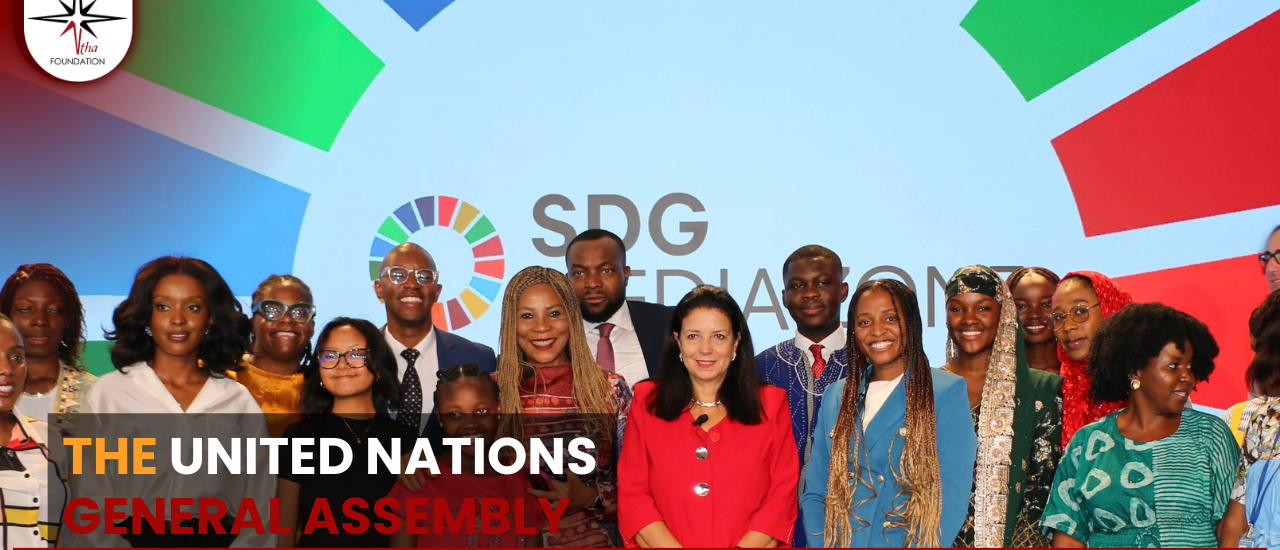
At UN Headquarters, the General Debate and mandated meetings provide the clearest indication of official political priorities. The Goals Lounge, running from 14 to 25 September, provides a more informal UN setting focused on partnerships and SDG implementation. The SDG Media Zone, from 21 to 25 September, translates policy discussions into public-facing conversations and can be particularly relevant for organisations seeking to place an issue into the broader development narrative.
For African organisations, Unstoppable Africa should be considered one of the major parallel convenings this year. The Global Africa Business Initiative’s flagship UNGA event is scheduled for 20 and 21 September at the New York Marriott Marquis and is expected to bring together heads of state, investors, business leaders, UN officials and entrepreneurs around trade, energy, industrialisation, digital transformation and African value creation.
Climate Week NYC runs from 20 to 27 September and spans more than 1,000 events. Its size makes selectivity essential. A participant working on energy or climate finance should identify the two or three forums where decision-makers relevant to a specific objective are likely to be present rather than treating the entire programme as an obligation.
The Concordia Annual Summit, scheduled from 20 to 23 September, occupies another part of the ecosystem, particularly for public-private partnerships, business-government engagement and philanthropy.
Permanent Missions also matter greatly. Many substantive bilateral discussions, receptions and issue-specific convenings take place through missions and will not necessarily be visible in public UN event listings.
The same applies to private meetings hosted by foundations, development institutions, companies, universities and investment platforms.
The distinction is important because an event’s public visibility does not necessarily correspond to its strategic value.
A closed thirty-minute meeting with the right institution may matter more than a plenary with 1,000 participants.
How the day should be structured
High-Level Week punishes over-scheduling.
New York traffic is difficult under ordinary circumstances. During UNGA it is compounded by road closures, security perimeters, motorcades and access queues. Meeting times move. Speakers arrive late. Bilaterals are rescheduled when ministerial programmes change.
A realistic day generally needs no more than one major anchor programme, two substantive meetings and one evening engagement.
Geographic clustering is as important as subject matter. Meetings around UN Headquarters should be grouped together. Times Square convenings should be grouped separately where possible. Travel buffers should be treated as part of the schedule rather than as unused time between events.
The most important thirty minutes of the day may be the period after the final engagement.
Delegations should review what changed.
Which conversation requires an immediate note?
Which introduction was promised?
Which request should be escalated?
Which opportunity is no longer worth pursuing?
Which contact needs a document before the following morning?
UNGA moves too quickly to postpone that analysis until the participant returns home.
What should be presented at UNGA81?
Participants invited to speak during High-Level Week often make the mistake of trying to present an entire institution.
The week does not reward institutional autobiography.
It rewards clarity.
A useful intervention should establish one problem, provide sufficient evidence to show why it matters, contribute a perspective that the room does not already have, and make clear what should happen next.
The organisational story should support the argument rather than replace it.
For Ntha Foundation, this year’s strongest substantive contribution sits at the intersection of human capital and productive capacity.
For years, African development policy has placed considerable emphasis on education, entrepreneurship, digital skills, youth empowerment and innovation. Those investments remain necessary. A second question has become increasingly difficult to avoid: where does that capability go once it has been created?
A young person can acquire digital skills and still enter an economy with too few firms capable of using them.
A graduate can possess strong technical knowledge and still face a labour market dominated by low-productivity employment.
An entrepreneur can build an innovative product and still confront unreliable electricity, expensive capital, weak logistics and fragmented markets.
A country can expand tertiary education and simultaneously increase skilled emigration because domestic productive systems cannot absorb the people it has trained.
This suggests a useful intervention for UNGA81:
Africa’s human-capital agenda now has to be connected much more deliberately to its productive-capacity agenda.
For Ntha Foundation, that argument can be grounded in experience rather than abstraction. Its work in digital skills, entrepreneurship, apprenticeships and innovation provides a basis for asking the next policy question: what firms, industries, public institutions and infrastructure systems must exist around trained young people if capability is to remain productive within African economies?
This also connects directly to several official UNGA81 priorities: SDG acceleration, digital inclusion, AI, development finance, climate, institutional reform and the future of multilateral cooperation.
The argument is stronger than another generic appeal to “invest in youth.”
It asks what the investment is supposed to become.
Youth representation should also mature
UNGA has become an important gathering point for global youth networks, and this has widened participation in international policy spaces. Manduwi’s own progression from participating in the UN system professionally to returning as a delegate representing youth and African interests illustrates part of that shift.
But youth participation itself should now be examined more critically.
Representation is necessary. Repeated representation without increasing authority is less transformative.
Young Africans should be present in advocacy spaces, but they should also be entering ministries, legislatures, regulatory institutions, development banks, companies, engineering organisations, research bodies and the diplomatic service itself.
A generation cannot indefinitely remain the constituency being consulted about decisions it will inherit.
UNGA should therefore be treated not only as a platform from which younger people speak to existing institutions but also as a place where they learn how those institutions actually function, how coalitions are built, how negotiations move and where formal authority resides.
The relevant transition is from participation to capability, and eventually from capability to institutional responsibility.
What African leaders should leave New York with
For heads of state, ministers and senior delegations, the standard should be considerably higher than attendance.
New York creates a rare compression of political leadership, international finance and institutional authority. It should be used accordingly.
An effective delegation should leave with negotiations advanced, financing conversations specified, bilateral relationships strengthened, unresolved technical issues assigned to named officials, and an explicit follow-up calendar.
A government seeking infrastructure finance should leave knowing which institution will assess the project and what information it requires.
A country negotiating around critical minerals should leave with a clearer understanding of processing, infrastructure, local-content and financing possibilities.
A delegation advocating Security Council or financial architecture reform should leave with a coalition strategy rather than another statement of principle.
A country seeking investment should be able to present actual investable opportunities rather than a general description of national potential.
This requires preparation inside government before the delegation arrives in New York. Foreign affairs ministries cannot carry the entire substantive agenda alone. Finance, trade, industry, energy, health and technology institutions need to feed into the negotiating strategy where relevant.
UNGA works best when diplomatic access is connected to technical preparation.
The work after UNGA
The return flight should not mark the end of the process.
In many cases, the most substantive conversations begin after High-Level Week, once officials, investors and institutions have returned to their normal calendars.
Within 72 hours, every promised document should be sent.
Within a week, substantive follow-up meetings should begin to enter calendars.
Within a month, organisations should be able to distinguish between relationships that produced movement and conversations that were simply cordial.
The assessment should return to the outcomes set before New York.
Did a financing process begin?
Did a government relationship deepen?
Did a policy proposal gain an institutional champion?
Did a partnership advance?
Did a project enter due diligence?
Did an organisation learn something that changes its strategy?
If none of those things occurred, the value of attendance should be questioned regardless of how busy the week felt.
That discipline is particularly important for organisations using scarce resources to attend international convenings.
From access to outcomes
The United Nations General Assembly remains one of the few places in the world where nearly every government can be found within the same institutional and geographic space at the same time.
That gives the week unusual value.
It also makes it unusually easy to mistake proximity for influence.
A delegate can stand beside heads of state and still advance nothing.
An organisation can appear on five panels and still leave without a partnership.
A government can deliver a strong speech while returning home with the same unresolved financing constraints it carried into New York.
The practical purpose of UNGA is not simply to be present at a global moment.
It is to understand what the moment makes possible.
UNGA81 arrives at a time of declining trust in institutions, pressure on development finance, geopolitical fragmentation, accelerating technological change, climate stress and a major reconsideration of the architecture of international cooperation. The official theme, “Restoring Trust, Managing Transformation: A United Nations That Delivers for All,” is therefore unusually well chosen. The central issue is increasingly delivery.
For African delegations, that same standard should apply.
The continent does not need another September in New York devoted primarily to explaining its potential.
Its priorities are already extensively documented.
The more consequential task is to convert political access into institutional influence, finance into productive capacity, partnerships into capability, and continental positions into agreements that survive the week in which they were announced.
That is how UNGA becomes useful.
And that is the basis on which delegates should plan the month before it, the week around it, and the work that follows.
Work With Us
Want to partner on or fund one of our programs / initiatives? We are always open to collaborations and partnerships. Contact our Founder; Ms. Nthanda Manduwi via contact@nthafoundation.org.
To keep up with the work of the Ntha Foundation, our hubs under the Kwathu Kollective, our initiatives, and our projects, follow us on social media:
NTHA FOUNDATION SOCIAL MEDIA
KWATHU KOLLECTIVE SOCIAL MEDIA